

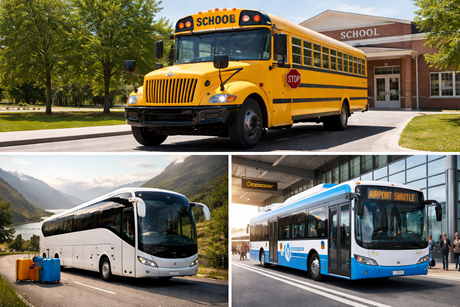
You rely on school bus transportation every day whether you notice it or not — it moves millions of students safely, on schedule, and at scale. School buses provide a predictable, cost-effective, and safety-focused way to get students to and from school, often more secure than car or walking trips and managed by regional operators and portals that keep routes and eligibility clear.
This article school buses transportation walks through how school bus systems work, what determines eligibility and routing, and the operational practices that keep services reliable. Expect practical details about booking, opt-outs, safety protocols, and how districts and private carriers coordinate so you can understand how the system serves your family or community.
School Bus Transportation Overview
This section explains why school buses matter, the common vehicle types used for student transport, and the safety standards that apply to design, operation, and oversight. You’ll find specific facts about crash risk, vehicle categories, and regulatory features that affect daily operations.
Purpose and Importance
You rely on school buses to move large numbers of students efficiently and with low per-student cost. School buses reduce family driving trips, lower traffic near schools, and concentrate supervision on trained drivers and attendants. Data indicate school buses have substantially lower injury and fatality rates per student trip than passenger cars or walking, which matters when you evaluate transport mode safety.
School bus services also support access to education across urban and rural areas. You benefit from route planning that balances directness with time-on-board limits and from policies that prioritize elementary student proximity to stops. Operators coordinate with school boards to match capacity to enrollment and special-needs requirements.
Types of School Buses
You will encounter several common bus types, each suited to specific route demands and student needs:
- Type A: Cutaway or van-based buses for small groups and tight routes; often used for special education and short rural runs.
- Type B/C: Conventional chassis with front-engine (C) or bus-body variations (B); common for standard neighborhood routes.
- Type D: Transit-style or rear-engine buses for high-capacity routes and long runs.
You should also note specialized variations: wheelchair-accessible buses with lifts or ramps, multi-passenger vans for very small loads, and activity buses for extracurricular trips. Fleet choice affects seating capacity, turning radius, fuel type, and maintenance schedules, so you should match bus type to route distance, road geometry, and student mobility needs.
Key Safety Standards
Regulations target both vehicle construction and operational practices to protect you and the students. Vehicle standards cover structural integrity (roof crush resistance), high-visibility paint and signage, school bus-type lighting and stop-arms, and secure seating with specified anchorages for restraints where required.
Operational standards affect driver qualifications, background checks, training in student management, and emergency evacuation drills. You will also see rules on maximum allowable driver hours, pre-trip vehicle inspections, and maintenance intervals. Technology requirements increasingly include GPS tracking, video surveillance, and automated stop-arm enforcement to improve compliance and incident response.
Operations and Best Practices
You need clear standards for drivers, routes, and vehicle upkeep to keep students safe and on time. Focus on documented procedures, measurable training outcomes, and scheduled preventive maintenance.
Driver Training and Certification
You must require a commercial or school bus endorsement and maintain a current medical certificate for every driver. Implement a documented training program that covers defensive driving, student loading/unloading procedures, emergency evacuation, and behavior management.
Use a combination of classroom instruction, behind-the-wheel coaching, and annual refresher courses. Track competencies with a checklist that includes road skills, student interaction, first aid/CPR, and use of any onboard safety equipment like crossing arms and CCTV.
Run periodic performance evaluations and random ride-alongs to verify adherence to policy. Keep training records for each driver organized by date, topic, instructor, and assessment result to meet regulatory audits and demonstrate continuous improvement.
Route Planning and Scheduling
Design routes using fixed criteria: maximum walk distance, number of stops per route, intersection safety, and peak traffic conditions. Prioritize direct routes for young students and avoid high-speed roads or complex intersections when safer alternatives exist.
Use software to model ridership loads, travel times, and fuel consumption. Validate digital plans with on-the-ground audits to confirm stop placements, loading zone visibility, and student crossing patterns during actual school hours.
Build schedules with buffer time for traffic variability and disciplinary incidents. Communicate precise pickup/dropoff windows to families, and publish emergency reroute protocols so you can adjust quickly during road closures or severe weather.
Maintenance and Inspections
Establish a preventive maintenance calendar based on mileage, engine hours, and manufacturer intervals. Include daily pre-trip inspections by drivers and detailed shop inspections (brakes, steering, suspension, lights) at defined mileage thresholds.
Document every maintenance action in a centralized log that records part numbers, labor, dates, and next inspection due. Use a simple table to track critical items:
| Item | Inspection Frequency | Action if Defect Found |
| Brakes | Every 5,000–10,000 mi | Remove from service until repaired |
| Tires | Daily visual; monthly depth | Replace when tread < 4/32″ |
| Lighting | Daily | Repair within 24 hours |
| Emergency equipment | Monthly | Replace expired items immediately |
Respond to driver-reported defects with a prioritized workflow and clear “out-of-service” criteria. Conduct post-repair road tests and retain sign-off evidence before returning a bus to service.